

Orach Technic Thin (ProGrav) is .ttf (TrueType) fonts and it is intended for engraving with CNC machines and Lasers.
* Font can optional be .otf (OpenType) for Apple computer, although Apple systems work correctly snd with .ttf fonts.
The Thin (ProGrav) font style contains 6,140 glyphs (characters) in version 7.22
The font looks like a One-line, but it is Two-line, so that it can be used in all graphics programs
such as Adobe Illustrator, Corel Draw, AutoCAD etc, and directly engrave with it,
or the font turned into curves and then export as an pdf, eps, dxff or plt file.

The font-style Thin (ProGrav), was made up to the limit of correct display on the monitor,
and it is made so that it writes in the center of styles ProGraf and ProCAD.

With Orach Technic ProGrav can engrave from Thin to Regular,
with different cutter "Tip Width" from 1/24 to 1/12H.
The relationship between "Tip Width" of the cutter and the size of the letter depends on several factors.
The depth of engraving, the
Shape of the cutters
(graver-knife-tools), and the
Measurement method of the Tip Width of the cutters.
The table shown above is theoretical and indicative.
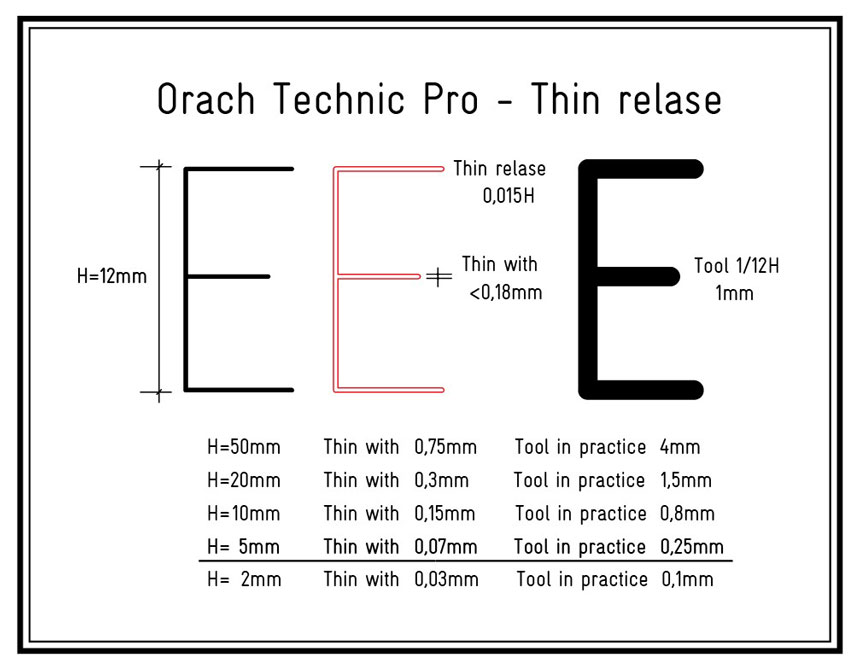
After many years of testing and real production work with the Orach Technic Pro – Thin (ProGrav) font we develope
the thinnest possible Thin font as a practical compromise between screen visibility and machine performance.
Anything thinner than this becomes poorly visible in CAM and CNC software and is uncomfortable to work.
The distance between the two lines is, in more than 90% of real engraving cases
practically equal to the thickness of a human hair
so in practice there is no visible difference compared to a true single-line (stroke) font.
The key advantage over single-line stroke fonts is that this version works reliably and correctly in both
graphic software and in most machining programs, using a standard .ttf font format.

Everything that a designer draws in graphic programs with the Orach ProGraf
can be directly engraved by simply replacing font-style with ProGrav and 1/12H knife.
Only those who are engaged in this business can know what a relief this is to the engravers.
What are the practical experiences with engraving this Two-line and One-line font.
Of course, single-line font writes faster, but that is insignificant in relation to time
it is necessary to make this graphic preparation.
If it is engraved on aluminum, brass, plastic 0.25-0,3 mm deep, for painting,
the two-line font proved to be better because it immediately clears the engraved letter.

Example of direct engraving on two-layer ABS engraving material 1mm thick,
with Orach Technic Thin (ProGrav), and knife 1/12 the height of capital letter.
Video Example direct engraving with Orach Technic Thin (ProGrav)

Example of direct engraving on inox boxes for business cards, with
Orach Technic Tnin (ProGrav), with a diamond tool 0,1mm.
Time 2 minuts.

En example of why only Orach Technic - Thin (ProGrav) can engrave directly from the graphic character of a letter.
Many uninformed will say that they can take any Thin or Ultra-light font and engrave this one,
but this is also impossible for several reasons. First of all, the design is not adapted for this purpose.
First of all, the letters are condensed into each other, sab-sub letters are not adjusted etc.
* * *
It should be kept in mind that the Orach Technic Pro Thin are displayed
in AutoCAD bolder than they are in reality,
while in illustrator and Corelu it is displayed correctly.

In some engraving programs it is displayed brighter and in others even bolder,
but that is due to the programs and their graphic display on the screen, not to our font.
-------------------------

-------------------------
|
Orach ProGrav
|
||
all Country - all Language - all Character - all Keyboard
The font supports more than 140 Windows keyboards and more than 215 languages.
Additionally, it can be used to write more than 1,600 languages.
+ Optional 4.075 files
Orach Technic Pro 7.22 - All Characters
(PDF document, 41 MB, 110 pages)
*Orach Technic Pro font is produced in InfoFORM Belgrade - Serbia, from 1988 to 2025

